Ms. Chadha arrived last night, which promises to improve life in hundreds of different ways, most of which are too sappy to share here. One change is that I can now visit all of the major monuments that I'd put off seeing (on Ms. C's instructions) while I awaited her arrival. The most obvious and convenient of these was a trip to the pyramids, so, the following morning, this is exactly what we did.
We wanted see more than just the Giza pyramids, so we decided to hire a guide and a driver for the day. Private, organized trips really aren't much more expensive than trying to arrange everything for yourself and if you're a particularly poor negotiator like me, may even cost less.
Private tours also provide a number of pleasant perks like a hotel pick-up (a convenience which is worth the difference in price alone), a car with air-conditioning, lunch, and a driver who actually knows how to get to the places you've asked to see. What you won't always get is a guide who is able to offer anything like reliable information about the monuments on the day's itinerary.
Our guide, a pleasant, chatty woman named Hana, had undermined her credibility before we even left downtown Cairo. As part of a bizarre, impromptu lecture on Egyptian military history, Hana explained how The country had never, in either ancient or modern history, initiated a war of agression. The only reason her country lost its [entirely defensive] war with Israel in 1948 was because unreliable allies had supplied it with defective tanks, artillery and rifles. Happily, Egypt was able to restore its national honor by defeating the combined armies of France, Great Britain and Israel during the 1956 Suez Crisis. No mention at all of the twin devastation threatened by the United States (economic) and the Soviet Union (nuclear) if the allies didn't withdraw. It was indeed a great victory, but it wasn't a military victory and I'm not sure how much credit Egypt deserves for it.
Luckily, the pyramids are impressive even if your guide believes that Colonel Nasser had them built just to irritate NATO. The Nile pyramids are so old that their true construction dates hardly register. To put their age in context, the first momument we visited, Zoser's step pyramid in Saqqara, was already considered ancient by the Greeks to described it. By the time Herodotus mentioned them some 2,500 years ago, the pyramids were already more than 2,000 years old.
The extraordinary size of the Giza pyramids is as difficult to appreciate as their age. With nothing nearby to compare them against, it's difficult to get a sense of scale - you see only row upon row of limestone blocks. Only when you approach the base of the pyramid do you realize that each block is 4'-5' tall. Of course, once you're near enough to recognize the size of an individual row of blocks, you're too close to see the number of levels or the pyramid's overall height. The Giza pyramids are so massive that it's difficult to find a vantage point from which you can appreciate just how enormous they really are.
We didn't linger too long. The temperature was already over 100 degrees and the touts, while not nearly as bad as I had heard, were still fairly aggressive. So, missing yet another opportunity to sit on an angry, abused camel, we drove on to the Sphinx.
You can't wander around the Sphinx the way I'd imagined. It's surrounded by the bedrock from which it was carved, so you're packed together with hordes of other tourists on a series of viewing platforms to the west of the monument. From the platform, you could see that what remained of the Spinx's face was crawling with pigeons. You can't look imposing with a face full of pigeons.
Quick language note: "sphinx" is pronounced as "sphink-ess" locally, because Arabic abhors both dipthongs and triple consonants. 'Sphinx' is transliterated as 'sphinks' in Arabic, and that 'nks' just won't do, so an extra 'e' is inserted before the final letter. You can hear the same thing with words like "thank-ess" or "rust-ess," the latter of which was printed on an ad for a car wash in Mohandiseen.
On the way back to the hotel, Hana asked if we would like to stop at the Papyrus Museum. We had already turned down a tour of one of the carpet "schools" in Saqqara, so we agreed to quickly stop by whatever "museum" our guide had affiliated herself with. I like this tactic of tarting up your souvenir shop by appending words like "museum" or "school" to the name. I look forward to visiting the "Polytechnical Institute of Spice" and the "National Center for the Advancement of Sheesha Sciences" before this trip is through. We at least knew what we were in for, and the fact that the museum passed out order forms at the door (just like at MOMA!) confirmed our suspicions. The presentation on papyrus manufacturing was interesting enough and besides the look of disappointment shared between our guide and the salesman when we asked to leave, there wasn't much pressure to buy. Not that we were much tempted to buy: the only items on offer were garish King Tuts and Queen Nefertitis which would have looked equally at home airbrushed onto the side of a 1984 Astrovan.
Back at a restaurant near the hotel, as I made my way through a plate of fatah (my new favorite food) I was happy to reflect on the fact that we had now 'done' the pyramids and could check it off our list. This was the first time I had felt anything like this in my two months here. I suppose it's because the pyramids are something you must see, but doing so can really be a bit of a hassle. The perfect metaphor for the whole experience was provided by an eight year old Bedouin girl sitting near the viewing platform exit. Having grown bored of the daily hustle, she was now monitoring the tourist flow and when anyone's ass was big enough to merit it, she would yell "heeeey Shakira!" and give it a good spank. We made it through unmolested, but a fair number of the members of an Alaskan tour group weren't so lucky. I'm sure that they were generally pleased to have made the visit, but something about the process must have struck them as undignified.
Showing posts with label culture. Show all posts
Showing posts with label culture. Show all posts
Thursday, March 18, 2010


Monday, February 15, 2010
Islamic Cairo
By the time I arrived at Midan Ahmed Maher to visit the Islamic Art Museum, I was already in a bad mood. I had gotten in yet another taxi-fight. This time, by proving once and for all that non-Egyptians really should pre-negotiate the fare for any journey of significant length. I followed all the ex-pat's advice, and will say only that it did not go smoothly. I miss the efficient, inexpensive, metered cabs of Morocco (or New York for that matter - not London though, who can afford a cab in London?). My mood didn't improve when I learned that the museum had been closed for renovations since 2002.
 My guidebook mentioned this possibility and suggested that I call to confirm the museum's status before going. That wasn't going to happen because I don't make phone calls, especially when I have no confidence in my language skills. Luckily for shut-ins like me, there is the internet. The museum's website seemed a little unsophisticated, but official websites in Egypt are rarely user-friendly, so I didn't think much of it. I saw later that it hadn't been updated since 2003, which still doesn't explain why it failed to mention that the museum was closed. It's strange that Egypt's tourist interface is sometimes so bad, since tourism is the country's largest source of revenue. The programming skills are certainly there: three or four times a week I rely on an awesome site where I can order delivery from one of about forty restaurants in the neighborhood. It's a little concerning (but also wonderful beyond measure) that so much of Egypt's modernization efforts appear to have centered on making it easier for me to effortlessly order fast food.
When plans go off the track, Cairo usually offers alternatives. I decided to take advantage of the great weather and walk through "Islamic Cairo," so called because of the large number of religious buildings in the district. The Bab Zwayla, which is as impressive a city gate as you're likely to see in your life, is a great starting point for any of a half-dozen walking itineraries in the area. Between the Bab Zwayla and the Northern Gates, you can enjoy an embarrassment of architectural riches. Palaces, mosques, wikalas and madrassas hem in the narrow market streets of the Khan el-Khalili; the old bazaar of Cairo. In terms of sheer density of religious architecture, I don't know if there's an equivalent anywhere else in the world. Even Rome gives it churches room to breathe.
I wasn't sure what to see. I had my guidebook, but didn't feel like flipping through the pages for recommendations. I found it much better to just visit whatever building happened to catch my eye as I wandered past. While it's sometimes a great way to get kicked out of a building, I've found that it's also a great way to discover hidden treasures and that you're much less likely to have to share them. At the newly restored Mausoleum of Al-Ghuri, for example, I was the only visitor. The lonely custodian was happy to let me climb up to the dome for some great views of the markets below. He was also happy to let me visit the cistern, where I almost got stuck because the stairs were so worn I couldn't climb back up them. The contrast between the silence of a mosque and the insanity of the street makes each more enjoyable to visit.
I found that in Rabat, visiting the souq isn't that different from visiting a shopping mall at home. I mean, there are some differences: in Rabat, you still might see a donkey packing out a new 40-inch flat screen on its back, but the thing is, in the Rabat souq, you could buy a 40-inch flat screen. Khan el-Khalili isn't anything like that. Other than Coca Cola, there is very little for sale that you couldn't have bought two hundred years ago. And while it's true that plenty of the shops trade in kitsch --ankhs, pyramids, busts of Nefertiti, charms to ward off the evil eye, sheesha pipes, genie lamps, etc.-- many others run serious businesses. In the Goldsmiths Bazaar running along the Sharia al-Muizz, little of the gold and silver jewelry (which is mostly sold by weight), is intended for tourists, who probably aren't carrying around that kind of cash.
 Not having much interest in jewelry, I walked the opposite direction down the Sharia al-Muizz, through the covered Tentmakers Bazaar (who sell exactly what you'd expect), and on towards the Citadel. The streets in this part of town are most definitely not tourist oriented. You can buy crates of live rabbits, chickens, ducks or pigeons (I tried to take a picture of the rabbits but the shop-keeper's eight-year-old son wasn't having it). I saw shops that traded exclusively in offal, with racks of lungs, brains, hearts and livers for sale. I was sorry to reflect that in the last three months, I've eaten all of these things. The raw organs looked better than the fish, however, which after suffering the indignity of spending their lives in the filthy Nile, now had to gasp their last breaths from under a layer of flies so thick I can't promise you that they actually were fish. It was a world apart from the seafood stands in Essaouira.
The only time to be thankful for Cairo's horrible pollution is during sunsets and when taking photos. The haze lends added drama to the ranks of minarets and domes receding in the distance. Every photo comes out in warm sepia tones that make it look like someone's been tinkering around in photoshop. I actually came back from my walk with a warm sepia tone myself, so much so that one of my roommates who had previously noted my pastiness, commented on how much sun I got. Sadly, my nice color came from a combination of dust, car exhaust and charcoal smoke. I came out of the shower looking as sickly as ever, which makes it that much less likely that I'll ever get a reasonable deal on a taxi.
 My guidebook mentioned this possibility and suggested that I call to confirm the museum's status before going. That wasn't going to happen because I don't make phone calls, especially when I have no confidence in my language skills. Luckily for shut-ins like me, there is the internet. The museum's website seemed a little unsophisticated, but official websites in Egypt are rarely user-friendly, so I didn't think much of it. I saw later that it hadn't been updated since 2003, which still doesn't explain why it failed to mention that the museum was closed. It's strange that Egypt's tourist interface is sometimes so bad, since tourism is the country's largest source of revenue. The programming skills are certainly there: three or four times a week I rely on an awesome site where I can order delivery from one of about forty restaurants in the neighborhood. It's a little concerning (but also wonderful beyond measure) that so much of Egypt's modernization efforts appear to have centered on making it easier for me to effortlessly order fast food.
When plans go off the track, Cairo usually offers alternatives. I decided to take advantage of the great weather and walk through "Islamic Cairo," so called because of the large number of religious buildings in the district. The Bab Zwayla, which is as impressive a city gate as you're likely to see in your life, is a great starting point for any of a half-dozen walking itineraries in the area. Between the Bab Zwayla and the Northern
 Gates, you can enjoy an embarrassment of architectural riches. Palaces, mosques, wikalas and madrassas hem in the narrow market streets of the Khan el-Khalili; the old bazaar of Cairo. In terms of sheer density of religious architecture, I don't know if there's an equivalent anywhere else in the world. Even Rome gives it churches room to breathe.
I wasn't sure what to see. I had my guidebook, but didn't feel like flipping through the pages for recommendations. I found it much better to just visit whatever building happened to catch my eye as I wandered past. While it's sometimes a great way to get kicked out of a building, I've found that it's also a great way to discover hidden treasures and that you're much less likely to have to share them. At the newly restored Mausoleum of Al-Ghuri, for example, I was the only visitor. The lonely custodian was happy to let me climb up to the dome for some great views of the markets below. He was also happy to let me visit the cistern, where I almost got stuck because the stairs were so worn I couldn't climb back up them. The contrast between the silence of a mosque and the insanity of the street makes each more enjoyable to visit.
I found that in Rabat, visiting the souq isn't that different from visiting a shopping mall at home. I mean, there are some differences: in Rabat, you still might see a donkey packing out a new 40-inch flat screen on its back, but the thing is, in the Rabat souq, you could buy a 40-inch flat screen. Khan el-Khalili isn't anything like that. Other than Coca Cola, there is very little for sale that you couldn't have bought two hundred years ago. And while it's true that plenty of the shops trade in kitsch --ankhs, pyramids, busts of Nefertiti, charms to ward off the evil eye, sheesha pipes, genie lamps, etc.-- many others run serious businesses. In the Goldsmiths Bazaar running along the Sharia al-Muizz, little of the gold and silver jewelry (which is mostly sold by weight), is intended for tourists, who probably aren't carrying around that kind of cash.
 Not having much interest in jewelry, I walked the opposite direction down the Sharia al-Muizz, through the covered Tentmakers Bazaar (who sell exactly what you'd expect), and on towards the Citadel. The streets in this part of town are most definitely not tourist oriented. You can buy crates of live rabbits, chickens, ducks or pigeons (I tried to take a picture of the rabbits but the shop-keeper's eight-year-old son wasn't having it). I saw shops that traded exclusively in offal, with racks of lungs, brains, hearts and livers for sale. I was sorry to reflect that in the last three months, I've eaten all of these things. The raw organs looked better than the fish, however, which after suffering the indignity of spending their lives in the filthy Nile, now had to gasp their last breaths from under a layer of flies so thick I can't promise you that they actually were fish. It was a world apart from the seafood stands in Essaouira.
The only time to be thankful for Cairo's horrible pollution is during sunsets and when taking photos. The haze lends added drama to the ranks of minarets and domes receding in the distance. Every photo comes out in warm sepia tones that make it look like someone's been tinkering around in photoshop. I actually came back from my walk with a warm sepia tone myself, so much so that one of my roommates who had previously noted my pastiness, commented on how much sun I got. Sadly, my nice color came from a combination of dust, car exhaust and charcoal smoke. I came out of the shower looking as sickly as ever, which makes it that much less likely that I'll ever get a reasonable deal on a taxi.
Thursday, February 11, 2010
Alexandria to Cairo
The Alexandria National Museum
This museum was outside the detailed map provided in my Rough Guide , which described it as being in an "Italianate mansion." Unfortunately for me, the neighborhood had plenty of these, so I accidentally visited an IT company and a private residence before I came to the right place. Next time I'll actually pay attention to the street numbers that the book had helpfully provided.
 The National Museum, particularly the ancient Egyptian, Greek and Rroman exhibitions, was a real pleasure to visit. I'm a big fan of New Kingdom art, which ranges from stark realism (most people will be familiar with the bust of Nefertiti) to caricature that appears almost modern. This head of Akhenaten, the pharaoh to whom Nefertiti was married, is a good example of the latter. I'm now that much more excited to go to the Egyptian National Museum.
The rest of the collection is Coptic and Islamic artifacts. The top floor contains a room of "treasures" which King Farouk was forced to abandon following Nasser's 1952 coup. Unless you're interested in 20th century French porcelain or English china, I'd give this room a miss.
Alexandria Library
The Bibliotheca Alexandria was conceived as a "rebirth" of the Ancient Library of Alexandria, which housed original manuscripts of Sophocles, Aeschylus and Euripides. The Austrian-Norwegian team who won the commission reflected this rebirth by designing a library in the shape of a giant discus, representing a new sun rising over the city. If there's anything I remember from my years as an architec ture school flunky, it's that taking too literal an approach to a concept is a bad idea. If you're building a train station, you should resist any urge to design a building in the shape of a train. The Bibliotheca Alexandria isn't shaped like a book, but the whole "rising sun" motif is a little heavy-handed for my taste.
The library also has letters, pictographs and hieroglyphs from every alphabet carved on the stone facing of the south wall, representing the breadth of knowledge the library contains. Again, a little gimmicky, but I still found myself obsessively counting how many of the symbols I could recognize as I loitered near the reflecting pool beneath the wall. The public spaces around the library are very active and the project appears to whole thing looks like it's been very successful at serving Alexandrians. I wish I had planned ahead and attended some of the events that are scheduled every day. On a weekend trip to Ljubljana last year, Ms. Chadha arranged tickets to a modern dance performance. I've tried ever since to incorporate that kind of thing into my traveling. I'm just not as good a planner as Ms. C.
I walked back along the corniche to my hotel room, bought a bottle of wine, and read on the balcony for the rest of the night. I'm already scheming how I'll get back to Alexandria soon.
Back to Cairo
My train wasn't leaving for an hour, so I went for a walk in the neighborhood just to the south of Alexandria's Masr Station. The streets were really bustling for 9:00 on a Sunday morning, which I suppose is more equivalent to Monday morning, so perhaps really not that interesting of an observation. At a juice stand, I watched the owner feed eighteen-inch lengths of sugarcane into a wheel press, collecting the resulting milky-green liquid in a tin bucket.
I had no idea what this stuff was called, but I was able to realize a long held fantasy by going up to the bar and asking for one "sugar juice," which I hoped would get the meaning across.* It did, and he served up two mug-fulls; one for me, and another so that he could demonstrate the safety and quality of his juice by drinking some himself. He took a quick pull on it, spitting a fair bit back into his mug, and then emptied the mug's contents back into the common pot. He had just given birth to exactly the concerns he hoped to dispel. I wasn't worried though, because what kind of bacteria could possibly survive in a warm brew of pure sugar water?
I took a deep pull of the juice. I had expected something really powerful, because I'd seen a travel program once where the host was absolutely destroyed by the sweetness of a similar drink. Maybe it's testament to my self-induced hyperglycemia that I wasn't fazed in the least - just one more thing to thank the folks at Coca Cola for. Fresh juice stands are one of my favorite things in the world, my only complaint is that because the juice is served in actual glasses or mugs, you're tethered to the stand and have to drink up on the spot. Sure, there's conversation sometimes, but more often than not, people just want to do their job without being bothered. I did ask the juice-guy whether next time I could have mine "bisukr," or "with sugar," which is how I normally order my tea. He acted like it was the funniest thing he'd ever heard, though he must have heard variations of the same joke every day for the last twenty years.
*I've since learned that this sugarcane juice is called "3aseer asab," which might mean "cane juice."
This museum was outside the detailed map provided in my Rough Guide
, which described it as being in an "Italianate mansion." Unfortunately for me, the neighborhood had plenty of these, so I accidentally visited an IT company and a private residence before I came to the right place. Next time I'll actually pay attention to the street numbers that the book had helpfully provided. The National Museum, particularly the ancient Egyptian, Greek and Rroman exhibitions, was a real pleasure to visit. I'm a big fan of New Kingdom art, which ranges from stark realism (most people will be familiar with the bust of Nefertiti) to caricature that appears almost modern. This head of Akhenaten, the pharaoh to whom Nefertiti was married, is a good example of the latter. I'm now that much more excited to go to the Egyptian National Museum.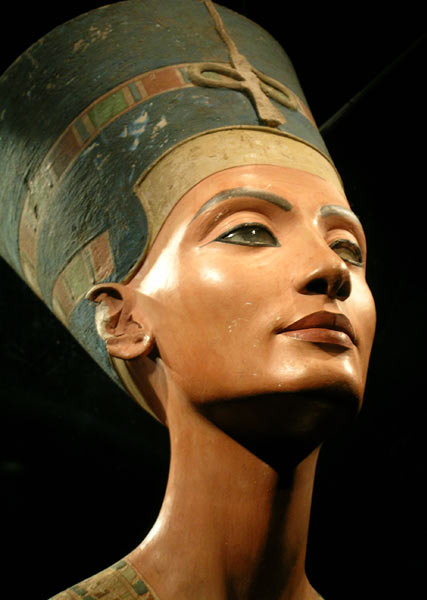
The rest of the collection is Coptic and Islamic artifacts. The top floor contains a room of "treasures" which King Farouk was forced to abandon following Nasser's 1952 coup. Unless you're interested in 20th century French porcelain or English china, I'd give this room a miss.
Alexandria Library
The Bibliotheca Alexandria was conceived as a "rebirth" of the Ancient Library of Alexandria, which housed original manuscripts of Sophocles, Aeschylus and Euripides. The Austrian-Norwegian team who won the commission reflected this rebirth by designing a library in the shape of a giant discus, representing a new sun rising over the city. If there's anything I remember from my years as an architec
 ture school flunky, it's that taking too literal an approach to a concept is a bad idea. If you're building a train station, you should resist any urge to design a building in the shape of a train. The Bibliotheca Alexandria isn't shaped like a book, but the whole "rising sun" motif is a little heavy-handed for my taste.
The library also has letters, pictographs and hieroglyphs from every alphabet carved on the stone facing of the south wall, representing the breadth of knowledge the library contains. Again, a little gimmicky, but I still found myself obsessively counting how many of the symbols I could recognize as I loitered near the reflecting pool beneath the wall. The public spaces around the library are very active and the project appears to whole thing looks like it's been very successful at serving Alexandrians. I wish I had planned ahead and attended some of the events that are scheduled every day. On a weekend trip to Ljubljana last year, Ms. Chadha arranged tickets to a modern dance performance. I've tried ever since to incorporate that kind of thing into my traveling. I'm just not as good a planner as Ms. C.
I walked back along the corniche to my hotel room, bought a bottle of wine, and read on the balcony for the rest of the night. I'm already scheming how I'll get back to Alexandria soon.
Back to Cairo
My train wasn't leaving for an hour, so I went for a walk in the neighborhood just to the south of Alexandria's Masr Station. The streets were really bustling for 9:00 on a Sunday morning, which I suppose is more equivalent to Monday morning, so perhaps really not that interesting of an observation. At a juice stand, I watched the owner feed eighteen-inch lengths of sugarcane into a wheel press, collecting the resulting milky-green liquid in a tin bucket.
I had no idea what this stuff was called, but I was able to realize a long held fantasy by going up to the bar and asking for one "sugar juice," which I hoped would get the meaning across.* It did, and he served up two mug-fulls; one for me, and another so that he could demonstrate the safety and quality of his juice by drinking some himself. He took a quick pull on it, spitting a fair bit back into his mug, and then emptied the mug's contents back into the common pot. He had just given birth to exactly the concerns he hoped to dispel. I wasn't worried though, because what kind of bacteria could possibly survive in a warm brew of pure sugar water?
I took a deep pull of the juice. I had expected something really powerful, because I'd seen a travel program once where the host was absolutely destroyed by the sweetness of a similar drink. Maybe it's testament to my self-induced hyperglycemia that I wasn't fazed in the least - just one more thing to thank the folks at Coca Cola for. Fresh juice stands are one of my favorite things in the world, my only complaint is that because the juice is served in actual glasses or mugs, you're tethered to the stand and have to drink up on the spot. Sure, there's conversation sometimes, but more often than not, people just want to do their job without being bothered. I did ask the juice-guy whether next time I could have mine "bisukr," or "with sugar," which is how I normally order my tea. He acted like it was the funniest thing he'd ever heard, though he must have heard variations of the same joke every day for the last twenty years.
*I've since learned that this sugarcane juice is called "3aseer asab," which might mean "cane juice."
Tuesday, February 09, 2010
Alexandrian Archaelogical Tour
The next morning, I slipped out before anyone else had woken up. I had planned a full day of museums and sightseeing, and I wasn't sure the Austrians would be up for that. I also knew that if I ran into them at breakfast, I wouldn't feel comfortable telling them that I wanted to spend the day alone, so I had to slink out in the early hours like a bad daddy.
Kom el-Dikka
Finding the mausoleum of Alexander the Great seems to be the only game in town for Alexandrian archaeologists. Every major site describes how it it had been discovered and excavated by teams of disappointed archaeologists who had actually been searching for the legendary tomb. This was the case at Kom el-Dikka (which literally means "mound of rubble") and though they failed to find Alexander, the site is still being excavated under the supervision of the Polish Center for Mediterranean Archaeology(?!). The tour buses hadn't arrived yet, so I shared the mound with a couple dozen laborers who, in a scene recreated a thousand times in films from Raiders of the Lost Ark to The Mummy, were carrying away piles of rubble in wicker baskets.
The Roman Theater is worth seeing as are the mosaics at the Villa of the Birds - just be sure to ask for a joint ticket at the door. Otherwise, you face a long walk back from the villa to the ticket office and the temptation will be too great to just peek at the mosaics though the window. They warrant a better look. There is also a fine selection of artifacts that have been recovered from the harbor over the last decade, which only whets my appetite to someday dive in Alexandria.
Catacombs of Kom es-Shoqafa
Contrary to common sense, everything I had read, and my own gut instinct, I had decided to follow the advice offered by an ex-pat regarding the best way to handle taxis. He suggested that negotiating taxi fare in advance was a mistake that would instantly peg me as a tourist. The thing to do was sit down, enjoy the ride, hand over the going fare at the end of the trip, and calmly walk away. I knew that the trip to the catacombs shouldn't cost more the LE 6-7, but I was more than happy to pay ten. We arrive at our stop and I suggest seven. The driver gave me a look that wasn't so much anger as fatherly concern that I hadn't learned better manners. I sheepishly passed him ten without another word, but then he told me that I owed him twenty. I wasn't having that at all, so the arguing began until I fell back on the reliable "I've lived in Cairo for a year now, I know what taxis cost" and I got away with only a light fleecing. "Fleecing" is all relative, of course, as ten pounds is only a couple of dollars, but to put it in context, I took the municipal tram back into to the center of town from the nearby Pompey's Pillar for slightly under five cents. I will have to discuss somewhere else my rationale for believing that it's important not to overpay too much for cabs. As for the ex-pat, I guess I didn't technically follow his advice exactly, so I can't quite claim that he is a complete and total fraud.
The Catacombs of Kom es-Shoqafa (which means "mound of shards" - it may be time for the Egypian Tourist Board to call in some consultants) is an amazing tomb complex that wasn't discovered until 1900, when a "donkey chariot" (sic) fell into one of the upper levels. You descend via a spiral staircase which, like the rest of the extensive rooms and halls of the catacomb, is carved directly out of the bedrock. Only two levels are accessible, as the bottom level remains under water, but the second level gives a good sense of the place. It's claustrophobic, damp, and a little creepy; all the things a catacomb should be. The decorations, if ever there were any, are mostly gone, except for a few murals visible only under UV light. The main carvings in the central tomb are a strange mixture of Roman, Greek and Egyptian themes - the most interesting being a pair of bas reliefs depicting Sobek and Anubis in Roman armor. It was too dark to get pictures on the cell phone camera, unfortunately, but the internet has gathered plenty if you're interested. Most definitely worth seeing.
On the way out, one of the security guards told be he would let me see the catacomb that was marked by a large "off limits - keep out" sign if I gave him LE 10 baksheesh. I was ready to say no, until I saw a pair of Australian tourists coming out of it giving a thumbs up. I took the money and set off down the passage. It's pretty clear that the reason the place was off limits was because it wasn't much more than a dark, dangerous, empty hole. Australians will give a thumbs up to anything.
Pompey's Pillar
 A five minute walk from the catacombs is Pompey's Pillar, so named because medieval travelers were under the impression that the severed head of the Roman general Pompey, who was murdered in Alexandria some time after his defeat by Julius Ceasar in the battle of Pharsalus, was in a jar on top of the column. It is now believed that the column was actually raised by Diocletian more than 200 years later, but the thing is nearly 27 meters high, which maybe explains why it took so long before somebody bothered to disprove this whole head-in-a-jar theory. In any event, the name stuck.
The attendant at the site's ticket booth asked me in perfect English whether I wanted a ticket, to which I sensibly replied "na'am! wahid! min fadlak!" (rough translation: yes! a father! please!). Once again I was complimented on my excellent Arabic, but this time my cryptic reply had evidently impressed them (ticket attendants are never without an entourage) so much that they had to know more, so the group begin to pepper me in Arabic with questions. Where was I from? How long had I studied? Did I like Egypt? Luckily, they were all asking questions at the same time, which allowed me to answer any question I chose, even ones they hadn't asked:
"I live in the borough of Brooklyn in the city of New York."
"I studied the Arabic language in Rabat, Morocco."
"I like strawberries, but I do not like carrots a lot."
"Maybe your pen is on his desk"
"We fly in a good bird yesterday to travel from my apartment to the Cairo, Egypt. He broken!"
I was a great success, and I think the interview could have gone on for some time as long as we talked exclusively about cities I had lived or studied in, since those are the only verbs in which I have complete confidence.
Sadly, I had other plans, I was here to see the pillar! Turns out that it's not a particularly interesting site, but I suppose the Washington Monument in DC has its admirers and they're both operating under more or less the same principle. Given the relative lack of things to see at the site, I was surprised to note that the tourist infrastructure surrounding the pillar was so good, with well-kept paths, effective lighting and useful signage, much better than the other sites I had visited that morning. It looks like someone is trying to show up the Polish Center for Mediterranean Archaeology. I'll bet it's the Germans.
Kom el-Dikka
Finding the mausoleum of Alexander the Great seems to be the only game in town for Alexandrian archaeologists. Every major site describes how it it had been discovered and excavated by teams of disappointed archaeologists who had actually been searching for the legendary tomb.
 This was the case at Kom el-Dikka (which literally means "mound of rubble") and though they failed to find Alexander, the site is still being excavated under the supervision of the Polish Center for Mediterranean Archaeology(?!). The tour buses hadn't arrived yet, so I shared the mound with a couple dozen laborers who, in a scene recreated a thousand times in films from Raiders of the Lost Ark to The Mummy, were carrying away piles of rubble in wicker baskets.
The Roman Theater is worth seeing as are the mosaics at the Villa of the Birds - just be sure to ask for a joint ticket at the door. Otherwise, you face a long walk back from the villa to the ticket office and the temptation will be too great to just peek at the mosaics though the window. They warrant a better look. There is also a fine selection of artifacts that have been recovered from the harbor over the last decade, which only whets my appetite to someday dive in Alexandria.
Catacombs of Kom es-Shoqafa
Contrary to common sense, everything I had read, and my own gut instinct, I had decided to follow the advice offered by an ex-pat regarding the best way to handle taxis. He suggested that negotiating taxi fare in advance was a mistake that would instantly peg me as a tourist. The thing to do was sit down, enjoy the ride, hand over the going fare at the end of the trip, and calmly walk away. I knew that the trip to the catacombs shouldn't cost more the LE 6-7, but I was more than happy to pay ten. We arrive at our stop and I suggest seven. The driver gave me a look that wasn't so much anger as fatherly concern that I hadn't learned better manners. I sheepishly passed him ten without another word, but then he told me that I owed him twenty. I wasn't having that at all, so the arguing began until I fell back on the reliable "I've lived in Cairo for a year now, I know what taxis cost" and I got away with only a light fleecing. "Fleecing" is all relative, of course, as ten pounds is only a couple of dollars, but to put it in context, I took the municipal tram back into to the center of town from the nearby Pompey's Pillar for slightly under five cents. I will have to discuss somewhere else my rationale for believing that it's important not to overpay too much for cabs. As for the ex-pat, I guess I didn't technically follow his advice exactly, so I can't quite claim that he is a complete and total fraud.
The Catacombs of Kom es-Shoqafa (which means "mound of shards" - it may be time for the Egypian Tourist Board to call in some consultants) is an amazing tomb complex that wasn't discovered until 1900, when a "donkey chariot" (sic) fell into one of the upper levels.
 You descend via a spiral staircase which, like the rest of the extensive rooms and halls of the catacomb, is carved directly out of the bedrock. Only two levels are accessible, as the bottom level remains under water, but the second level gives a good sense of the place. It's claustrophobic, damp, and a little creepy; all the things a catacomb should be. The decorations, if ever there were any, are mostly gone, except for a few murals visible only under UV light. The main carvings in the central tomb are a strange mixture of Roman, Greek and Egyptian themes - the most interesting being a pair of bas reliefs depicting Sobek and Anubis in Roman armor. It was too dark to get pictures on the cell phone camera, unfortunately, but the internet has gathered plenty if you're interested. Most definitely worth seeing.
On the way out, one of the security guards told be he would let me see the catacomb that was marked by a large "off limits - keep out" sign if I gave him LE 10 baksheesh. I was ready to say no, until I saw a pair of Australian tourists coming out of it giving a thumbs up. I took the money and set off down the passage. It's pretty clear that the reason the place was off limits was because it wasn't much more than a dark, dangerous, empty hole. Australians will give a thumbs up to anything.
Pompey's Pillar
 A five minute walk from the catacombs is Pompey's Pillar, so named because medieval travelers were under the impression that the severed head of the Roman general Pompey, who was murdered in Alexandria some time after his defeat by Julius Ceasar in the battle of Pharsalus, was in a jar on top of the column. It is now believed that the column was actually raised by Diocletian more than 200 years later, but the thing is nearly 27 meters high, which maybe explains why it took so long before somebody bothered to disprove this whole head-in-a-jar theory. In any event, the name stuck.
The attendant at the site's ticket booth asked me in perfect English whether I wanted a ticket, to which I sensibly replied "na'am! wahid! min fadlak!" (rough translation: yes! a father! please!). Once again I was complimented on my excellent Arabic, but this time my cryptic reply had evidently impressed them (ticket attendants are never without an entourage) so much that they had to know more, so the group begin to pepper me in Arabic with questions. Where was I from? How long had I studied? Did I like Egypt? Luckily, they were all asking questions at the same time, which allowed me to answer any question I chose, even ones they hadn't asked:
"I live in the borough of Brooklyn in the city of New York."
"I studied the Arabic language in Rabat, Morocco."
"I like strawberries, but I do not like carrots a lot."
"Maybe your pen is on his desk"
"We fly in a good bird yesterday to travel from my apartment to the Cairo, Egypt. He broken!"
I was a great success, and I think the interview could have gone on for some time as long as we talked exclusively about cities I had lived or studied in, since those are the only verbs in which I have complete confidence.
Sadly, I had other plans, I was here to see the pillar! Turns out that it's not a particularly interesting site, but I suppose the Washington Monument in DC has its admirers and they're both operating under more or less the same principle. Given the relative lack of things to see at the site, I was surprised to note that the tourist infrastructure surrounding the pillar was so good, with well-kept paths, effective lighting and useful signage, much better than the other sites I had visited that morning. It looks like someone is trying to show up the Polish Center for Mediterranean Archaeology. I'll bet it's the Germans.
Subscribe to:
Posts (Atom)